Identify Your Brand Essence
When articulating brand essence, a Venn Diagram is a useful way to illustrate the correlations between ideas.

 Once you’ve identified your brand and brand book keywords, it’s essential to test them and demonstrate their relationship to your brand position to create your brand essence. From our last post, you’ll recall that we settled on the following keywords: imagination, friend, joy, clean, charity, children, Dream, chubby, Bathtime, and squeeze. To explore the relationship of these keywords to each other, we will use a Venn Diagram.
Why include a Venn Diagram to Illustrate Brand Essence?
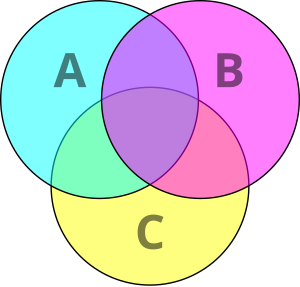
Venn Diagram via Wikipedia
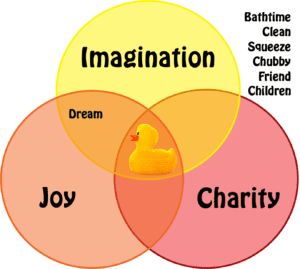 We need to identify the three BIG ideas in our keywords. Likely suspects, based on the work we’ve already completed, include Joy, Charity, Imagination, Friends, Children, and Clean. For the sake of this exercise, let’s assume the big three are Joy, Imagination, and Charity. As you can see, we label our big circles with our big ideas and then try to work the remaining keywords into their location between the big ideas. For instance, where joy and imagination overlap, dreams exist. Problems start arising, however, when we try to identify what happens when the big ideas overlap with Charity. None of the keywords we identified seem to make sense for where Imagination and Charity overlap. In a world of imagination and charity, we don’t get bathtime, clean, squeeze, chubby, friends, or children. We might get innovation or fundraisers, but we didn’t identify those as keyword brand attributes. So Charity is a wrong choice for the big idea — OR we misidentified our keywords.
 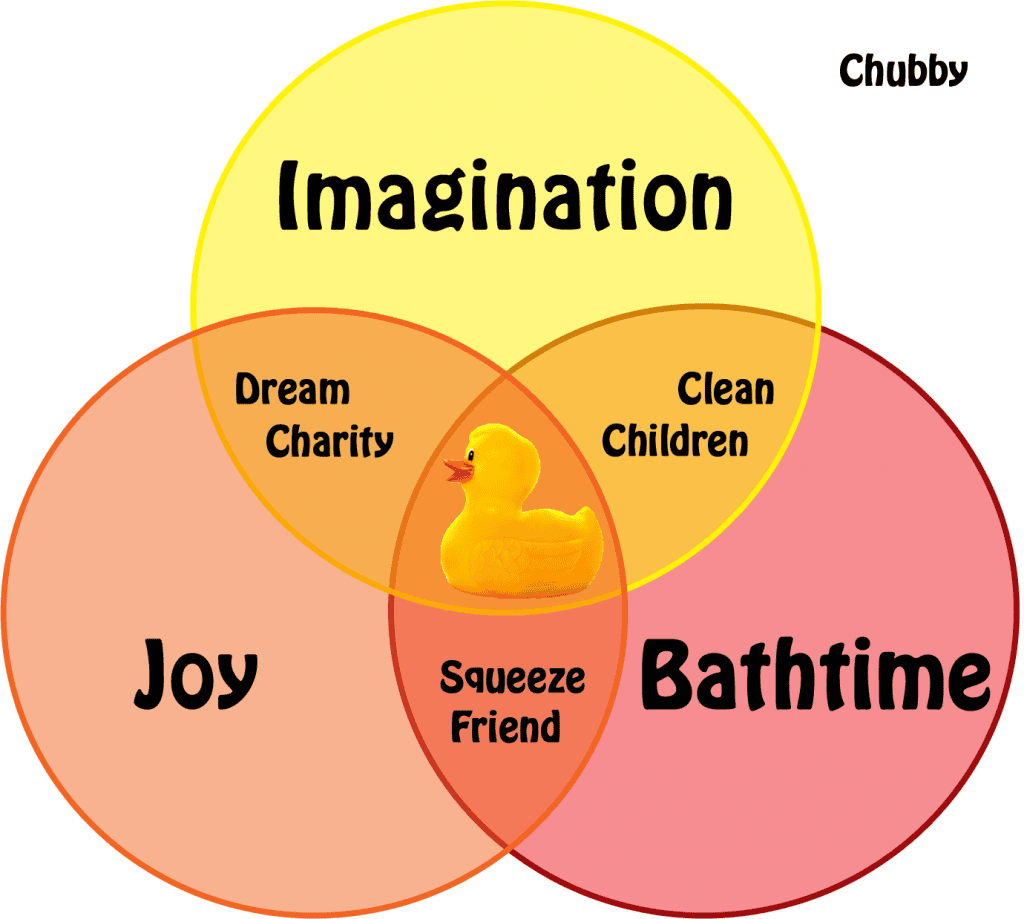 Let’s try a different version of the three BIG ideas: Joy, Imagination, and Bathtime. A little more traditional – authentic, perhaps more reflective of the brand’s roots and not what it is evolving toward, but let’s try it. When we cross Imagination with Bathtime, we get Clean and Children — that seems right. When we cross Imagination and Joy, we see our previously identified Dream and Charity now. That fits. When we cross Joy with Bathtime, we get Friend and Squeeze. Those are both excellent fits; the Rubber Duckie is a friend at Bathtime, delivering joy to children and adults alike–and I dare you not to squeeze it.
Where Does “Chubby” fit in the Brand Book?
It’s a key element of the brand—all Rubber Duckies are chubby—but it doesn’t really fit at the intersection of the big ideas. The brand book has three ways to deal with this problem.
- It might be time to reconsider our big ideas and find some that fit better.
- We could throw it out.
- We could embrace it for what it is and use a marketing technique such as acronyms to help.
Right now, we will acknowledge that it doesn’t fit our brand and leave it set aside in our brand book. We may discover where the word Chubby fits in with future analysis for our brand book, and perhaps we won’t, in which case we will edit the Keywords and Venn diagram as we pull all our pieces together for the final draft. (Remember, I told you writing a brand book could be a bit of a vicious circle at the outset of this process.) We now have a working model of our Venn Diagram in the brand book. It has helped us understand that while Charity may play an essential emerging role in the Rubber Duckie brand, it does not play a significant role, and that’s OK — Rubber Duckie got its start at Bathtime. It makes sense that Bathtime should continue to play a vital role in the brand position. It also helped us to understand we may have a problem with Chubby. So, the exercise helped us further identify our brand position AND helped articulate our position for individuals who may read our Brand Book later.
See More From the Brand Book Tutorial Series


Tisha Oehmen is the Chief Branding Officer and co-founder of Paradux Media Group. With more than 30 years of experience in branding, marketing, and business strategy, Tisha brings a practical perspective shaped by helping businesses understand who they are, what makes them different, and how to communicate that clearly. An award-winning brand strategist and best-selling author of two books on branding, she believes the strongest brands aren’t manufactured—they’re uncovered, understood, and built to last.
Related Articles
What Clients Say
“Tisha and Garrett have been wonderful to work with. They are very knowledgeable about websites, marketing, SEO. They have both been prompt and efficient in…

We love working with Paradux. They are very professional, always responsive, learn very quickly about a wide variety of businesses and industries, and produce first-class…


“Paradux is top notch – they know their stuff and always take excellent care of me. I get so many compliments on my website! I’ve…

We love working with Tisha and Paradux. They are professional, very responsive, and are able to dive in and learn about a wide variety of…

I loved working with Paradux on updating our website to look more modern! They are very responsive and incredibly fast at getting things done. I’m…

“Paradux worked quickly and efficiently to quickly get an ad campaign together for our biggest annual fundraising event. I will be using them every year…

“I loved working with Paradux on updating our website to look more modern! They are very responsive and incredibly fast at getting things done. I’m…

“The team at Paradux was wonderful to work with. Their expertise, assistance, grace, and personality were such a joy in our partnership on a video…

Always willing to work with us on our (sometimes very specific) marketing needs.